How to Choose the Right Commercial Range: Standard Duty vs. Heavy Duty
- Aug 25, 2025

Selecting the right range for your kitchen isn’t just about brand preference—it’s about matching your operation’s daily demands with equipment that balances performance, durability, and value. Not every kitchen needs the same level of power, and over- or under-buying can both create problems down the road.
This quick guide breaks down when to choose a standard-duty range versus a heavy-duty range, with examples of trusted models from Garland, Southbend, and Vulcan.
When a Standard-Duty Range Makes Sense
Best for: cafés, small diners, churches, community kitchens, or any operation serving fewer than ~150 meals per day.
A standard-duty range is a smart option for kitchens that focus on lighter cooking tasks such as sautéing, simmering, or baking. These ranges aren’t intended for constant use with large stock pots or heavy cast iron cookware, and their ovens perform best when used occasionally rather than all day.
They’re designed to balance performance with affordability, making them ideal for operations that want dependable results without the higher upfront and operating costs of heavy-duty equipment. For cafés, diners, and other small to mid-sized foodservice operations, a standard-duty range often provides exactly what’s needed without overbuilding.
Use a standard-duty range if your kitchen:
- Focuses on lighter cooking tasks (sautéing, simmering, baking).
- Doesn’t regularly cook with large stock pots or cast iron.
- Uses ovens occasionally rather than continuously.
- Values a lower upfront cost and lower operating expenses.
Key features of standard-duty ranges:
- Burners deliver ~24,000-30,000 BTU, adequate for moderate cooking.
- Lighter construction - thinner metal, less stainless steel - keeps cost down while meeting typical needs.
- Designed for balanced performance and affordability without overbuilding.
Example models:
Garland G-Series Range
Dependable for light-to-medium duty kitchens. Delivers consistent heat and durability, ideal for cafés, diners, and community kitchens.

Vulcan SX Range
Entry-level option with lower-BTU burners. Best for modest or occasional use, offering Vulcan quality at a budget-friendly price.

Southbend S-Series Range
A reliable workhorse with efficient controls and practical design. Suited for everyday cooking tasks with simple upkeep.

When Heavy-Duty Ranges Are Worth the Investment
Best for: hotels, hospitals, large restaurants, institutions, or any kitchen where high-volume or continuous cooking is the norm.
A heavy-duty range is the right choice for kitchens that regularly produce large meal counts with little downtime between shifts. These ranges are built to handle heavy cookware, such as large stock pots and cast iron pans, which require stronger burners and sturdier grates. They are also ideal for operations that rely on ovens throughout the day, whether for high-temperature baking, roasting, or convection cooking.
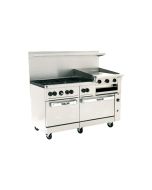
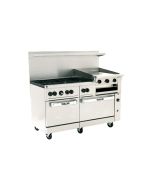
Because they are designed for durability and longevity, heavy-duty ranges are well-suited to multi-shift operations where equipment sees near-constant use. In addition, they offer modular configurations—such as griddles, planchas, and charbroilers—that can be customized to support specialized workflows in high-volume kitchens.
Key features of heavy-duty ranges:
- Burners deliver ~32,000-40,000 BTU for faster cooking and more power.
- Rugged construction with welded frames, thicker gauge steel, and heavy-duty knobs and grates.
- Configurable “battery” lineups to match a kitchen’s exact cooking flow.
- Long-term payoff in durability and lower replacement costs.
Example models:
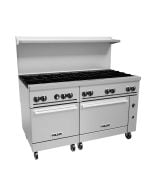
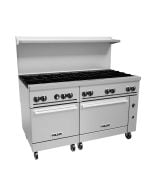
Garland Master Series
High-performance range with powerful burners, modular design, and easy maintenance. Built for continuous, high-volume kitchens.
Garland Cuisine Series
Rugged yet modern, featuring Starfire Pro burners, stainless surfaces, and easy-to-clean components for heavy-duty use.
Southbend Platinum Series
Premier heavy-duty option with full stainless construction, water-resistant panels, and modular base choices for demanding kitchens.
Vulcan V-Series
Heavy-duty range with ~35K BTU burners, rugged build, and customizable tops. Reliable for high-volume, long-term performance.

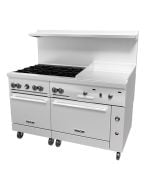
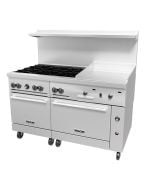
Heavy-duty ranges are designed for more than just power—they’re built to adapt to the unique demands of busy kitchens. Whether you need a lineup with open burners for flexibility, griddles for high-volume breakfast service, or charbroilers for constant grilling, these ranges can be configured to support your exact workflow.
Their modular design allows you to create a cooking station that fits your menu and maximizes efficiency. Our team can guide you through the available options to ensure you get the best setup for long-term performance.
Call us to customize a range that fits your needs
Matching a Range to Your Kitchen’s Needs
Choosing between standard and heavy-duty isn’t always obvious. Here are some guiding considerations that can help narrow down the right fit:
- How many meals per day will you serve?
Meal volume is the first sign of range type. Under ~150 meals often fits standard duty, while higher counts lean heavy duty. - What’s the daily runtime?
Short meal periods suit standard duty, but long hours or multi-shift kitchens need the durability of heavy duty. - What cookware will you use most?
Light pans work fine on standard duty, but heavy stock pots or cast iron call for sturdier, heavy-duty construction. - How often will ovens be in use?
Occasional baking is fine for standard duty, while frequent, high-temp roasting or baking requires heavy duty. - Do you need a modular setup?
Standard ranges cover basics, but if you need griddles, charbroilers, or other custom lineups, heavy duty offers flexibility. - What’s your budget vs. long-term plan?
Standard duty saves upfront, but heavy duty pays off with longer life and fewer replacements over time.